Wednesday, August 1, 2012

Give-A-Way!
(It's Not To Late, You Can Still Enter to Win A $25.00 Gift Card)

To Enter Your Name In the Drawing First, You Must Be a Subscriber of My Blog (Easy) and Second, You Must Like the FaceBook Fan Page of My Favorite Zumba Sisters, Deb and Alva.( Easier)
Click Here to Like Their Fan Page. Thats All!
You Have Until Tuesday August 7, 2012 11:59pm to Enter.
Remember You Must Be A Subscriber of my Blog, and Like the FaceBook Fan Page Of Deb and Alva.
The Winner Will Be Announced on Wednesday August 8, 2012.
There Will Be Two Winners, the Prizes Will Be A $25.00 Visa Gift Card For Each Winner. The Winners Name Will Be Displayed on My Blog on August 9, 2012. The Winner(s) Will Have Until August 16, 2012 to Claim Their Prize. Good Luck!

If you have any questions please email me at manageu08@gmail.com

The Ultimate Happy Hour!


The “Ultimate” Happy Hour

Introducing the New Sin Free, Calorie Free, and Guilt Free Night Out!


August 7, 2012

4:00pm-7:00pm


No Happy Hour is Complete Without Good Friends and Good Times. So Grab a Friend(s), and Gold’s Gym Will Serve Up the Good Times!  This isn’t Your Typical Happy Hour, In Fact We Can’t Tell You, but We Can Show You! It Gets Better, There Will Be Give-A-Ways, Non Member Tours, and No Happy is Complete Without (Alcohol-Free) Cocktails!


Tuesday, July 31, 2012

Want More Defined Curls?

I have stated in previous blogs post that I follow an Ayurvedic regimen. Here are some photos of the process.

What I Used:
Cocoveda Oil
Amla
Hibiscus Petal Powder
Brahmi
Bhringraj
Trader Joes Moisture Balance Conditioner

Prior to my treatment I applied the Cocoveda Oil as a pre-poo, and left it in over night. Then I co-washed my hair, ayurvedic herbs and treatments can be very drying on the hair, so I make sure to prep my hair with a deep conditioner.

Mixture (Cocoveda oil, herbs, and TJMBC)

Hair sectioned and pre poo applied)

Application (See the curl definition immediately)


Application Process

Application

Application

Done with the application
Hair immediately after rinsing out the treatment


Hair immediattely after rinsing ou the treatment

Fully air dried hair


I am obsessed with Ayurvedic herbs and so is my hair. My hair felt incredibly soft after I rinsed out the treatment. My curls were more elongated, and clearly more defined. I only have a quarter sized amount of product in my hair, and that's my leave-in (Kinky Curly Knot Today). Usually I use more styling products, but after this treatment I didnt really need it. If you have any questions leave a comment an I will get back to you as soon as I can.


Monday, July 30, 2012

Give-A-Way!
(It's Not To Late, You Can Still Enter to Win A $25.00 Gift Card)

  To Enter Your Name In the Drawing First, You Must Be a Subscriber of My Blog (Easy) and Second, You Must Like the FaceBook Fan Page of My Favorite Zumba Sisters, Deb and Alva.( Easier)
Click Here to Like Their Fan Page. Thats All!
You Have Until Tuesday August 7, 2012 11:59pm to Enter.
Remember You Must Be A Subscriber of my Blog, and Like the FaceBook Fan Page Of Deb and Alva.
The Winner Will Be Announced on Wednesday August 8, 2012.
 There Will Be Two Winners, the Prizes Will Be A $25.00 Visa Gift Card For Each Winner. The Winners Name Will Be Displayed on My Blog on August 9, 2012. The Winner(s) Will Have Until August 16, 2012 to Claim Their Prize. Good Luck!

If you have any questions please email me at manageu08@gmail.com

Sunday, July 29, 2012

How porosity can help you choose the best products for your hair.

Porosity refers to the hair's ability, or inability, to absorb water or chemicals deep into the cuticle layers and cortex. All hair is naturally porous and somewhat permeable to water.
Low or "poor porosity" refers to hair that does not readily absorb moisture and resists chemical treatments. Poor porosity is not exactly a problem that should cause you great concern. It is, however, ideal to have hair that falls somewhere in the middle of the two porosity extremes: hair with good porosity that retains moisture well and accepts chemical treatments.
The Sponge
Our hair has the ability to absorb up to 50% of its weight in water! This absorption and lengthening is why wet hair feels heavier than dried hair. Think of a sponge. When the sponge is fresh and new, it is able to absorb a good amount of water and hold the moisture inside very well. As the sponge ages, the pores become distorted, the fabric of the sponge is weaker, and it begins to lose its shape. Because the old sponge cannot hold the amount of water it once could, it is said to be more porous or have higher porosity than the new sponge.
The following questions will help you determine whether or not your hair is overly porous:
Does your hair continuously soak in moisture without ever actually feeling moisturized?
Is your hair chronically dry despite your best conditioning efforts?
Does your hair appear/feel puffy, frizzy, swollen, or tough to the touch?
Does your hair have a natural, reddish toned cast to it that is usually more pronounced in spring and summer time?
Does your hair hold styles and curl well?
If you've answered yes to any of the above hair characteristics, and these characteristics appear more pronounced toward the ends of your hair, you may have a problem with your hair's porosity level.
Causes of Porosity Problems There are two main conditions that aggravate the physical integrity of the cuticle layer, and thus, the hair's porosity level.
The first is soundness of each cuticle scale along the hair strand.The soundness of the cuticle scales refers to the smoothness of each individual hair scale surface. Weak or damaged scales are often worn, cracked, and may even have holes in them. The more damaged an individual scale is, the more porous that scale will be.
The second is the general spatial arrangement of the cuticle scales relative to one another. Lifted scales are porous simply because they are not lying flat against the others. They will let moisture out easily. The unavoidable constant lifting and closing of the cuticle layers over time through regular washing, conditioning, and chemical processing increases the overall porosity of the hair. The ends of the hair are typically the most porous because the cuticle layers in this region have simply been opening and closing the longest. If the individual scales are porous, and the scales are lifted up and away from one another, the porosity situation is compounded.
So what exactly damages the cuticles in those ways?
Specifically, hair porosity is affected by excessive exposure to:
mechanical and heat abuse from combs, brushes, and heat styling tools,
the sun, overprocessing from chemical relaxers and permanent colors,
and the continued use of sodium lauryl or ammonium lauryl sulfate-rich shampoos.
Porosity Problems for the Relaxed and Color Treated
Relaxing or colored treating the hair with chemicals forces the cuticle layers up and open. Unfortunately, when this happens, these chemical treatments increase the porosity of the hair by both means: by degrading the cuticle layers and causing them to lift dramatically. In time, the cuticle layers do eventually close on their own, but if the damage is repeated too often by either back to back coloring jobs, heat overuse, or relaxing too frequently those cuticle layers may never close fully again. For this reason, relaxed and color treated individuals should be extra diligent about managing their hair's porosity.
Porosity Tests
It is best to measure your level of porosity on freshly cleaned and dried hair.
Test 1: Wet your hair. Before you start to shampoo your hair, notice how long it takes for your hair to actually feel soaked and fully saturated with water. Hair that "wets" easily is typically porous. If your hair takes quite some time to actually get fully wet, your hair is less porous. (Or your hair could be coated with heavy oils and other products!) As your hair dries (air dry), note how quickly the drying takes place. Porous hair dries very quickly, and in some cases, the ends of the hair may be dry before your body is fully dried! Hair that takes longer to dry is typically less porous.
On fully dried hair, note whether your hair feels rough and tangles easily. Hair that "catches" on itself, does not move well, and tangles easily is usually porous, or is in need of a trim.
Test 2: Gently hold strands of your dry hair between your index finger and thumb, and then slowly slide your fingers along the length of the strand. You should be moving from the scalp to the ends. If you feel an overall uneven texture as you move along down the shaft, your hair is slightly porous.
Test 3: Take a few strands of "harvested" hair (shed hair from your comb, hair brush, etc.) and place them in a bowl of water. If the hair sinks in less than a minute or two, it is porous. The sooner your hair sinks, the more porous it is. If only one part of the strand sinks, you have a spotty porosity problem. This is not uncommon.
Once you have performed one or more of the porosity tests and believe that your hair is indeed porous, read Part 2 of this Porosity Series to learn ways that you can treat your own porosity issues.
How porosity can help you choose the best products for your Hair.

Porosity refers to the hair's ability, or inability, to absorb water or chemicals deep into the cuticle layers and cortex. All hair is naturally porous and somewhat permeable to water.
Low or "poor porosity" refers to hair that does not readily absorb moisture and resists chemical treatments. Poor porosity is not exactly a problem that should cause you great concern. It is, however, ideal to have hair that falls somewhere in the middle of the two porosity extremes: hair with good porosity that retains moisture well and accepts chemical treatments.
The Sponge
Our hair has the ability to absorb up to 50% of its weight in water! This absorption and lengthening is why wet hair feels heavier than dried hair. Think of a sponge. When the sponge is fresh and new, it is able to absorb a good amount of water and hold the moisture inside very well. As the sponge ages, the pores become distorted, the fabric of the sponge is weaker, and it begins to lose its shape. Because the old sponge cannot hold the amount of water it once could, it is said to be more porous or have higher porosity than the new sponge.
The following questions will help you determine whether or not your hair is overly porous:
Does your hair continuously soak in moisture without ever actually feeling moisturized?
Is your hair chronically dry despite your best conditioning efforts?
Does your hair appear/feel puffy, frizzy, swollen, or tough to the touch?
Does your hair have a natural, reddish toned cast to it that is usually more pronounced in spring and summer time?
Does your hair hold styles and curl well?
If you've answered yes to any of the above hair characteristics, and these characteristics appear more pronounced toward the ends of your hair, you may have a problem with your hair's porosity level.
Causes of Porosity Problems There are two main conditions that aggravate the physical integrity of the cuticle layer, and thus, the hair's porosity level.
The first is soundness of each cuticle scale along the hair strand.The soundness of the cuticle scales refers to the smoothness of each individual hair scale surface. Weak or damaged scales are often worn, cracked, and may even have holes in them. The more damaged an individual scale is, the more porous that scale will be.
The second is the general spatial arrangement of the cuticle scales relative to one another. Lifted scales are porous simply because they are not lying flat against the others. They will let moisture out easily. The unavoidable constant lifting and closing of the cuticle layers over time through regular washing, conditioning, and chemical processing increases the overall porosity of the hair. The ends of the hair are typically the most porous because the cuticle layers in this region have simply been opening and closing the longest. If the individual scales are porous, and the scales are lifted up and away from one another, the porosity situation is compounded.
So what exactly damages the cuticles in those ways?
Specifically, hair porosity is affected by excessive exposure to:
mechanical and heat abuse from combs, brushes, and heat styling tools,
the sun, overprocessing from chemical relaxers and permanent colors,
and the continued use of sodium lauryl or ammonium lauryl sulfate-rich shampoos.
Porosity Problems for the Relaxed and Color Treated
Relaxing or colored treating the hair with chemicals forces the cuticle layers up and open. Unfortunately, when this happens, these chemical treatments increase the porosity of the hair by both means: by degrading the cuticle layers and causing them to lift dramatically. In time, the cuticle layers do eventually close on their own, but if the damage is repeated too often by either back to back coloring jobs, heat overuse, or relaxing too frequently those cuticle layers may never close fully again. For this reason, relaxed and color treated individuals should be extra diligent about managing their hair's porosity.
Porosity Tests
It is best to measure your level of porosity on freshly cleaned and dried hair.
Test 1: Wet your hair. Before you start to shampoo your hair, notice how long it takes for your hair to actually feel soaked and fully saturated with water. Hair that "wets" easily is typically porous. If your hair takes quite some time to actually get fully wet, your hair is less porous. (Or your hair could be coated with heavy oils and other products!) As your hair dries (air dry), note how quickly the drying takes place. Porous hair dries very quickly, and in some cases, the ends of the hair may be dry before your body is fully dried! Hair that takes longer to dry is typically less porous.
On fully dried hair, note whether your hair feels rough and tangles easily. Hair that "catches" on itself, does not move well, and tangles easily is usually porous, or is in need of a trim.
Test 2: Gently hold strands of your dry hair between your index finger and thumb, and then slowly slide your fingers along the length of the strand. You should be moving from the scalp to the ends. If you feel an overall uneven texture as you move along down the shaft, your hair is slightly porous.
Test 3: Take a few strands of "harvested" hair (shed hair from your comb, hair brush, etc.) and place them in a bowl of water. If the hair sinks in less than a minute or two, it is porous. The sooner your hair sinks, the more porous it is. If only one part of the strand sinks, you have a spotty porosity problem. This is not uncommon.
Once you have performed one or more of the porosity tests and believe that your hair is indeed porous, read Part 2 of this Porosity Series to learn ways that you can treat your own porosity issues.

Shrimp Pasta with Tomatoes, Lemon and Spinach

Print Friendly
I wish I could replace the inside of my mouth with this.

AND, I’m just now figuring something out. I think angel hair pasta might be my favorite pasta in the entire world, including Vermont. I dunno, something about the thinness, the slipperiness of it, how evenly it gets coated by sauces, how much of it you can get in your mouth at one time, and ohhh, the fact that it’s called ANGEL. HAIR. I mean really, does that not beg for a classic Bev wig joke or what? I’ll wait for the end of this post to make it though. Long after you’re gone.

I’m acting like this is the first time I’ve ever eaten angel hair, and it’s totally not. Aaron made it with a meat sauce the other night and I nearly lost the last of my now three marbles. Angel hair should run for president. OF HEAVEN.
I keep typing “angle” hair.

BUT, I think this is my favorite way to eat the angel hairs. Super rustic-like with lots of sautéed garlic (have you noticed how much better I’m getting about the accent thingy?), lemony shrimp, HERBS.
Omg, you guys. Speaking of, I’ll have to show you my garden later. OOC.*

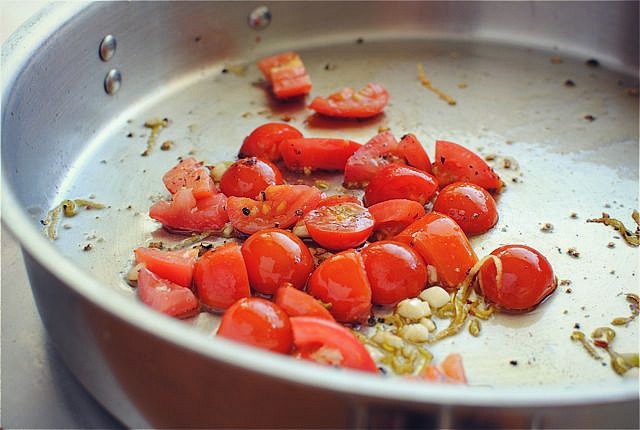
A lil’ bit o’ crushed red pepper for a smidge of heat. Lightly sautéed cherry tomatoes from the garden in all that garlic and lemon zest. Hoooooly. Tossed with angle, I MEAN ANGEL hair pasta and olive oil and pasta water and baby spinach and seared shrimp and OH AWESOME I’m now down to two flippin’ marbles.


. . . One.

Someone send an ambulance.

Okay so I’m leaning towards an angel hair Pulp Fictiony blunt bob. Or wait, no! RAPUNZEL.
Shrimp Pasta with Tomatoes, Lemon and Spinach:
What it took for 2:
* 1/2 pound extra large shrimp, thawed, peeled and deveined
* 2 tsp lemon zest, divided
* 1 pinch crushed red pepper
* 1 sprig fresh thyme, leaves removed and chopped
* 1 sprig fresh oregano, leaves removed and chopped
* 2 basil leaves, torn
* 2 Tbs. extra-virgin olive oil
* 2 cloves garlic, minced
* 1 cup cherry tomatoes, halved
* 4 cups baby spinach
* 2 Tbs. lemon juice (or more!)
* 1/2 pound angel hair pasta
* coarse salt and freshly ground pepper
On a plate, toss the shrimp with the crushed red pepper, half the lemon zest, chopped herbs and a pinch of salt and pepper. Let it sit while you start the rest.
Heat the oil in a medium skillet over medium-high. Add the garlic and bloom 30 seconds. Add the tomatoes along the remaining lemon zest. Sprinkle with a little salt and pepper and saute for 2 minutes.
Add the shrimp in a single layer and sear on one side for 2 minutes. Flip and sear another minute, or until shrimp is cooked through. Keep tossing the tomatoes just a little bit.
In the meantime, bring a large pot of salted water to a boil and cook the angel hair until al dente, maybe 5 minutes. Drain all but about 1/2 cup of the pasta water and toss with the shrimp and tomato mixture, along with the spinach. Squeeze a lot of lemon juice right in. Season with coarse salt and pepper. Add as much pasta water as you want to create a thin, glorious sauce.
Serve it with more lemon juice, crusty bread and for heaven’s sake, fresh parmesan cheese.
*out of control